The work between
Music, visual art, publishing and interior architecture have something in common: the work does not end with the finished form. It creates the conditions for places, works and people to continue evolving.

In July 2026, a work trip took me back to Quito. Some cities are easy to move through; others ask, first of all, to be listened to. Quito belongs to the latter. One of the first cities to be inscribed on the UNESCO World Heritage List, in 1978, the Ecuadorian capital has one of the best-preserved historic centres in Latin America. Its streets reveal a layered history, where colonial heritage meets Indigenous cultures, pre-Columbian roots and contemporary artistic practices. Together, they shape the many ways in which the city continues to express its identity. Quito changes the rhythm of looking. It asks you to observe before interpreting, to understand the context before deciding what something means.
Over time, I have come to realise that this attentiveness is not limited to places. It also shapes the way I approach cultural projects. Every intervention emerges from a particular context, from relationships and histories that take time to understand. My work unfolds between observation, interpretation and translation across different languages and forms—a practice developed primarily in Switzerland and opened, through international collaborations, to other contexts and perspectives.
The path has never been linear. It is closer to a constellation of experiences across different fields, connected by a common question: how can a cultural project create relationships without reducing the complexity of the context in which it takes shape? Cultural mediation, in this sense, becomes a practice of listening and connection—a space where different ideas, people and practices can meet and create new meanings.
Drawing as a space for connection
A mural does more than change a wall. It can change the way a neighbourhood sees itself.
This idea runs through the work of Grupo Bananart.ec, an Ecuadorian urban art project founded by cultural promoter Jorge Fernando Manríquez Pozo. Working in schools, institutions and public spaces, the collective brings artists, local communities and public authorities together in processes of urban regeneration. Over the years, it has created more than five hundred murals across Ecuador. In Quito alone, twelve large buildings have been transformed into monumental works that engage with the city’s heritage and the everyday life of its neighbourhoods.
Public art becomes a space for cultural mediation, where the value of the work lies not only in the finished piece but in the relationships that bring it into being: conversations with residents, collaboration between artists, engagement with place and the creation of a shared visual language. The mural is the visible trace of a process that continues long after the work itself is complete.

The same collaborative approach shaped the visual identity of Espacios, the José Pino Trio’s international tour, and the Zurich-based cultural platform La casa de nadie. Original illustrations by Ecuadorian artist Jofer Manpo do more than accompany the two projects: they interpret them, translating a dialogue between art, research and different cultural contexts into images.
The T-shirts developed with Bananart for both projects function as small cultural editions in their own right. The Espacios shirt incorporates a QR code linking directly to the album on Bandcamp, turning a physical object into a point of access to the music. Image, music and digital content coexist within a single object, extending the project beyond the concert itself.
Illustration, local production, music and material form are part of a single creative process. The object does not simply document a project; it extends the experience and opens up new possibilities for encounter.
Perhaps this is the hardest part to convey. Culture almost always leaves behind something recognisable—a mural, a concert, a book—while the process that brought it into being tends to disappear from view. The conversations, collaborations, doubts and transformations that shaped it become invisible. Yet it is often in this hidden space that a project finds its meaning.
Every score is a new reading
Ecuadorian composer and musician José Pino, who has lived in Switzerland for more than a decade, works between continuity and change. His compositions draw on Ecuadorian popular music, jazz, electronic and contemporary music, bringing different traditions into dialogue. Among them is the Ecuadorian pasillo, inscribed on UNESCO’s Representative List of the Intangible Cultural Heritage of Humanity in 2021. Pino approaches it not as a tradition to be preserved, but as living material, open to reinterpretation. In July 2026, that dialogue returned to where it began. His Ecuadorian tour brought an artistic practice developed in Europe back into contact with the cultural context that continues to shape it.
For the tour, Pino formed a trio with pianist Ricardo Subía and drummer Roberto Morales, both active on Quito’s jazz scene. Together they developed a repertoire grounded in dialogue and improvisation. For the Quito concerts, they were joined by violinist Fernanda Delgado of the Orquesta Sinfónica Nacional del Ecuador, bringing contemporary composition, jazz and orchestral practice into the same musical space.
Following the José Pino Trio on tour also gave me the opportunity to document the concerts through photography and film. The camera became a way of observing how the same music changed from one place, audience and context to another. Photography and film were not simply a record of what had happened, but part of a project still in motion.
The same openness is present in musical notation. A score does not fix a work in its final form; it makes another reading possible. Each performance brings composer, musicians, space and audience into a different constellation. Essential Scores, a series by La casa de nadie Editions, publishes lead sheets by contemporary composers with this principle in mind. Their pared-back notation leaves room for interpretation and improvisation, allowing the music to change with each performance.
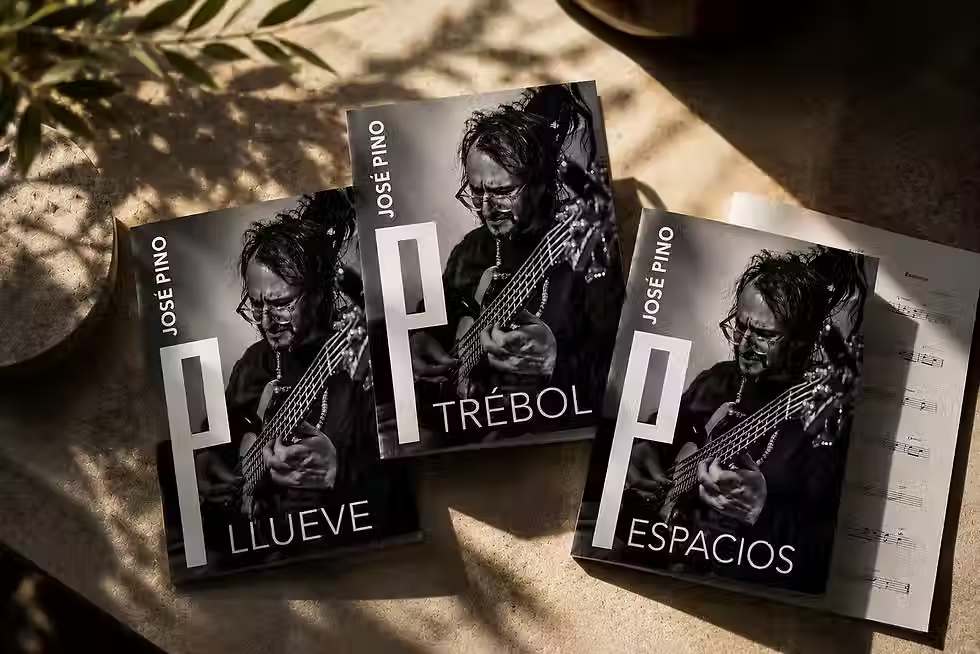
Publishing a score means allowing a work to remain open. The page holds the composition; the musicians give it another life.
This is perhaps what draws me most to cultural work: creating the conditions for a work to be encountered again, read differently and transformed over time.
Inhabiting heritage
During the same stay in Ecuador, in July 2026, a more personal project also began to take shape.
The renovation began with the kitchen.
The choice was not incidental. Long the shared heart of the house, the kitchen retains the central role around which a particular way of living, rooted in the building’s history, has evolved. Its layout reflects a traditional residential type found on the slopes of Quito: shared spaces—the kitchen, courtyard and laundry—around which individual rooms are arranged, each with its own entrance along the outdoor staircase climbing the hillside. It is a configuration shaped by the topography and by a way of life built around the relationship between private and communal space.
The kitchen thus became the starting point for a broader reflection on domestic heritage.
The intervention is not about replacing what is there, but allowing it to evolve. The original glazed terracotta floors have been preserved, while the interior surfaces underwent careful remediation, waterproofing and refinishing to restore their quality and durability without erasing the traces of the building’s past. Against this backdrop, the new elements introduce a restrained language of white, black, champagne and stone. Minimal wall units, a masonry worktop, ceramic surfaces and metal details establish a discreet contemporary presence, allowing material, proportion and the memory of the building to define the character of the space.
The same principle will guide the next phase. A lightweight structure in steel and glass, conceived as a habitable extension of the house, will connect the built edge of the hillside with the inner courtyard. The new architecture will shelter the external staircase and create balconies, a veranda and light-filled workspaces designed to accommodate Amazonian vegetation.
The courtyard is part of the same vision. Where concrete has replaced the soil, the sparse vegetation that remains still holds traces of the original garden: an old Andean cedrón, a generous lemon tree with orange-coloured fruit and a wild rose. These plants retain a connection to the surrounding landscape, offering shelter and sustenance to passing butterflies and hummingbirds, while only hinting at the natural richness the site could once again support. The project will reintroduce a kitchen garden and a garden of native species, restoring the relationship between architecture, landscape and everyday life.
The new glazed structure also responds to Quito’s unusual climate: a city on the equator, yet suspended high in the Andes. Considered one of the world’s highest major cities after La Paz, Quito extends across elevations of roughly 2,500 to 3,500 metres, where intense Andean sunlight during the day gives way to markedly cooler temperatures at night. In a context where domestic heating is largely absent, architecture can improve thermal comfort through passive strategies. Conceived as a contemporary greenhouse, the new extension will collect heat during the day and gradually release it into the surrounding spaces. A technical response that also reflects a broader approach: designing with the climate rather than against it.
The project suggests another way of thinking about heritage. Not as something to be preserved at a distance, but as a resource from which new ways of living can emerge. A building can continue to tell its story only if it continues to be lived in.
Inhabiting a neighbourhood
The perspective now widens to the future of Chimbacalle.
Today, the neighbourhood bears the traces of slow change. Over recent decades, many families have moved away, some schools have closed and numerous buildings await new investment. Yet this relative marginality has also allowed Chimbacalle to retain a distinctive urban identity.
Chimbacalle’s streets climb the hills that frame Quito. From its steep lanes, the view opens towards El Panecillo and the Virgin, seen from behind her left shoulder—a perspective rarely found in images of the city. A few blocks downhill are the historic Chimbacalle railway station, no longer served by trains but now the focus of plans for cultural renewal; the covered market, still part of the neighbourhood’s daily rhythm; and the Teatro México, restored after years of neglect and once again part of the cultural life of southern Quito.
During our stay, we also came across a small Marian procession moving through the neighbourhood. Accompanied by a band and clouds of incense, the statue of the Virgin made its way slowly past shops and houses, stopping at businesses that had displayed her image for the traditional blessing. Only a few people took part, but the intimacy of the procession revealed an everyday religious practice still closely woven into neighbourhood life.
For José Pino, who grew up in Chimbacalle, the procession brought back another image from childhood. He remembers the Fiestas de Quito when celebrations still unfolded across the city’s neighbourhoods rather than following a centralised programme. Stages, concerts, popular bands and events organised by residents filled the streets, turning them for a few days into places where children, families and musicians came together.
Those memories also raise a question about Chimbacalle’s future. Could culture bring new life to the neighbourhood without turning it into a destination shaped by tourism or property speculation? Music, visual arts, artist residencies, small workshops and affordable places to stay for students, researchers and independent travellers could find a place within an architectural and human landscape that remains remarkably rich. La Candelaria in Bogotá offers one point of comparison: a historic neighbourhood where an independent cultural scene has grown alongside everyday urban life.
Celebration, then, is more than a tradition to remember. It can also be a way of bringing public space back into use. Concerts, artistic initiatives and occasions to gather return the streets to a familiar role: places where a community meets, tells its stories and imagines what might come next.
Chimbacalle is a neighbourhood of layers: buildings of locally made brick, later alterations, traces of its railway history, restored cultural spaces and collective practices that remain part of everyday life. The roofs tell a similar story. Alongside traditional corrugated metal is the techo español, a lightweight composite material that echoes the profile of old colonial tiles in a contemporary, affordable form.
Imagining a future for Chimbacalle does not mean gentrifying the neighbourhood or turning it into an open-air museum. It means finding ways for heritage, culture, private initiative and the quality of everyday space to sustain life in the neighbourhood.
Just outside the gate of the house, a small urban intervention offers a glimpse of what this might mean. A paved area where the lane begins, two-tone stone underfoot, a young tree marking the entrance, new shrubs along the slope and a coat of white paint bringing light back to the walls: small changes that alter the perception of an everyday space without grand gestures. The transformation is slight, almost imperceptible. What makes it most conspicuous is the large municipal sign announcing the work: Quito renace—Quito is reborn. Yet it takes very little to suggest that the transformation of a neighbourhood might begin here.
Inhabiting the historic centre
A similar perspective emerges in Quito’s Centro Histórico, where independent initiatives are finding new ways to connect heritage with everyday urban life. Pata Caliente, founded by Galo Benítez, offers a different way of moving through the historic centre: not as a collection of monuments, but as a lived fabric of people, businesses, memories and places often missed by conventional routes.
At the heart of the project is a simple idea: unused historic buildings can become part of everyday life again. Food, art and craft bring new activity into old spaces, creating places where residents and visitors can meet. La Caponata is one example: a restaurant in a carefully restored colonial house, where Sicilian cuisine shares space with cultural and creative activities.
A few steps away, Casa del Marqués follows the same principle. Around a shared courtyard, food, artisan workshops, popular theatre and other cultural initiatives occupy spaces opening onto the surrounding galleries. Past and present remain visible at once: waxed wooden galleries, original glazing, stucco and old floors of stone and coloured tiles preserve the character of Quito’s Spanish colonial architecture, while new uses bring the buildings back into everyday life.
During a walk through the Centro Histórico organised by Pata Caliente, Benítez showed us a lane descending towards Plaza Grande and the Presidential Palace. It had been redesigned partly in response to requests from people who use the historic centre every day. Trees now line the route, creating a safer distance between pedestrians and traffic. Buses still hurtle down the slope, but no longer dominate the street entirely. For Benítez, the difference lies in ordinary things: walking the dog, meeting neighbours, stopping in the square, experiencing the streets once again as places of shared life.
Food, too, can change the way a city is lived. Places that remain active into the evening create reasons to stay, meet and spend time in public space. What changes is not only the building, but the life around it.
From Chimbacalle to the Centro Histórico, the same question returns: how can a city change without losing its connection to the places that give it form? Quito renace—the municipal motto seen on signs and public vehicles across the city—suggests one answer: to see what already exists not only as a trace of the past, but as a possibility for the future.
Cities rarely change through a single gesture. Change accumulates through smaller interventions, relationships and forms of everyday care: a house restored, a street returned to the community, a historic building given a new use. Sometimes transformation begins not by building something new, but by recognising the value of what is already there and allowing it to evolve.
Creating conditions
Looking back at the projects brought together in these pages, what connects them becomes clearer. A concert, a T-shirt, a score, a house: different forms through which a cultural project takes shape and continues to evolve. Each raises the same question: how can a culture continue to change without losing touch with what gave rise to it?
Between Switzerland and Ecuador, cultural mediation has come to mean a practice of observation, listening and interpretation. It is not about finding equivalences between different realities, but about creating relationships that make room for difference and allow dialogue to take place.
Perhaps this is where cultural work finds its meaning: not in the finished object alone, but in the relationships, interpretations and transformations that gather around it. A project does not end when it takes form. It continues in the places it changes, the encounters it makes possible and the new readings it invites.
Martina Knecht
Quito, July 2026
Text and Images © Martina Knecht
Further reading
José Pino
Ecuadorian composer, musician and producer based in Switzerland, working across Latin American music, jazz, electronics, electroacoustic and contemporary composition.
Espacios
José Pino’s 2026 album, shaped by an artistic journey between China, Switzerland and Ecuador.
La casa de nadie
Zurich-based independent cultural platform for art practice and dissemination.
Essential Scores
A series by La casa de nadie Editions publishing lead sheets by contemporary composers, designed to remain open to interpretation and improvisation.
→ Explore catalogue
La casa de nadie Boutique
Essential Scores editions and illustrated T-shirts developed with Grupo Bananart.ec.
Grupo Bananart.ec
Ecuadorian urban art collective working with artists, schools and local communities on murals and public-space projects.
Pasillo: song and poetry
The Ecuadorian pasillo was inscribed on UNESCO’s Representative List of the Intangible Cultural Heritage of Humanity in 2021.
Quito, World Heritage City
Quito’s historic centre has been a UNESCO World Heritage Site since 1978.
→ UNESCO
Swiss Hypertext
Editorial work across language, culture and design.
→ Explore Swiss Hypertext